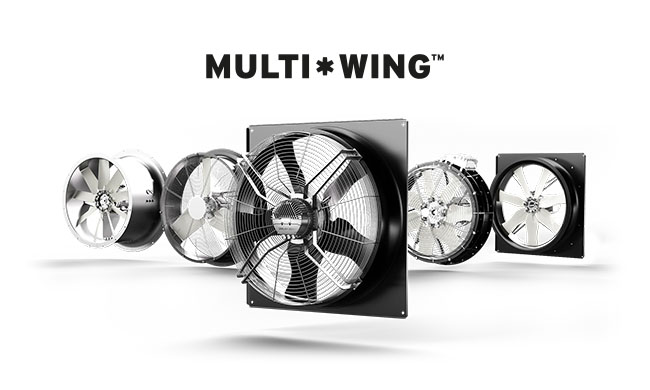
At Multi‑Wing Group, our mission is “Shaping airflow for future generations”. We are a global leader in custom‑designed axial fan solutions for the HVAC/R and powertrain cooling industries.
For more than 60 years, we have developed an innovative modular system that enables a very wide range of tailor‑made axial fans for customers all over the world. By optimizing airflow, we help deliver more efficient, flexible, and quieter heating and cooling – contributing to a safer, healthier planet for future generations.
To strengthen our Motors & Drives organization, we are now looking for a Mechanical Engineer, Motors & Drives to join our R&D team in Denmark.
The Role
As Mechanical Engineer, Motors & Drives, you will be responsible for the mechanical design, development, and optimization of components and subsystems for:
- Electric motors
- Drive electronics housings (VFDs and other electronics enclosures)
- Related integration parts used in axial fan applications
You will work on motor housings, shafts, bearing arrangements, sealing and cooling concepts, structural components, interfaces, and mounting systems. A key focus is to protect motors and electronics from water ingress while still providing sufficient airflow and thermal cooling in demanding industrial environments.
You will play a central role in ensuring mechanical robustness, manufacturability, reliability, thermal performance, and long‑term durability of our motor and drive solutions. You will collaborate closely with electrical motor designers, R&D colleagues, manufacturing, procurement, quality, and suppliers across regions.
Mechanical Design & Development
- Design mechanical components for motors and drives from concept to production release.
- Create 3D models, drawings, and specifications for housings, shafts, bearings, end‑caps, covers, brackets, cooling structures, seals, drainage concepts, and assembly interfaces.
- Design and optimize electronics housings integrated into industrial fans, with strong focus on:
- Water ingress prevention
- Condensation and drainage
- Airflow and cooling performance
- Perform structural, thermal, and vibration simulations (FEA and related analyses) to ensure reliability and compliance.
- Ensure designs comply with industry standards, regulations, internal design rules, and customer specifications.
Materials & Manufacturing Engineering
- Select appropriate materials, coatings, and surface treatments for mechanical parts exposed to:
- Humidity, splash water, dirt, cleaning agents
- Temperature cycling and vibration
- Evaluate and balance trade‑offs between aluminum, stainless steel, coated steel, engineered polymers, die‑cast materials, and elastomers, considering:
- Corrosion resistance and galvanic compatibility
- Thermal conductivity and dimensional stability
- Chemical and UV resistance
- Weight, manufacturability, and long‑term durability
- Collaborate with manufacturing to optimize designs for machining, casting, moulding, forming, and assembly.
- Support DFM, DFA, and DFMEA activities and contribute to supplier evaluations.
Ingress protection & cooling performance
- Develop enclosure and interface concepts that minimize water ingress into motors and electronics while maintaining required cooling airflow.
- Define strategies for gaskets, seals, labyrinths, venting elements, drainage concepts, sealing surfaces, fastening strategies, and joint design.
- Balance environmental sealing and thermal dissipation to ensure robust performance in real operating conditions.
- Support validation and design improvements related to IP performance, condensation, thermal behavior, and durability.
Testing, validation & continuous improvement
- Support prototype builds, mechanical testing, design verification, and root cause analysis.
- Participate in validation related to ingress protection, thermal performance, vibration, fatigue, corrosion, and assembly robustness.
- Use test feedback and field experience to improve designs and reduce reliability risks over time.
How You Will Work With Others
Team collaboration
- Work as part of a cross‑functional product team, providing solid mechanical engineering input and judgment.
- Coordinate closely with R&D, manufacturing, procurement, quality, and suppliers to communicate requirements, risks, and design trade‑offs.
Stakeholder & customer interaction
- Translate complex mechanical challenges into clear and actionable messages for non‑technical stakeholders.
- Provide mechanical input in customer discussions, ensuring requirements around environmental protection, cooling, and integration are understood and built into the design.
Global & internal communication
- Collaborate with global teams, respecting cultural and regional differences.
- Produce clear documentation and design records accessible also to non‑engineers.
- Capture and share feedback from customers, manufacturing, field service, and internal teams so that product improvements are based on real application learning.
- Contribute to training and knowledge sharing around mechanical design, materials, ingress protection, and motor/drive integration.
- Support the process of keeping stakeholders informed about design changes, technical risks, validation outcomes, and project progress through structured and timely communication.